Introducing The Bearish Diamond Formation

For years, market aficionados and forex traders alike have been using simple price patterns not only to forecast profitable trading opportunities but also to explain simple market dynamics. As a result, common formations such as pennants, flags and double bottoms and tops are often used in the currency markets, as well as many other trading markets. A less talked about, but equally useful, pattern that occurs in the currency markets is the bearish diamond top formation, commonly known as the diamond top. In this article, we'll explain how forex traders can quickly identify diamond tops in order to capitalize on various opportunities.

The diamond top occurs mostly at the top of considerable uptrends. It effectively signals impending shortfalls and retracements with relative accuracy and ease. Because of the increased liquidity of the currency market, this formation can be easier to identify in the currency market than in its equity-based counterpart, where gaps in price action frequently occur, displacing some of the requirements needed to recognize the diamond top. This formation can also be applied to any time frame, especially daily and hourly charts, as the wide swings often seen in the currency markets will offer traders plenty of opportunities to trade.

Identifying and Trading the Formation
The diamond top formation is established by first isolating an off-center head-and-shoulders formation and applying trendlines dependent on the subsequent peaks and troughs. It gets its name from the fact that the pattern bears a striking resemblance to a four-sided diamond.

Let's look at a step-by-step breakdown of how to trade the formation, using the Australian dollar/U.S. dollar (AUD/USD) currency pair (Figure 1) as our example. First, we identify an off-center head-and-shoulders formation in a currency pair. Next, we draw resistance trendlines, first from the left shoulder to the head (line A) and then from the head to the right shoulder (line B). This forms the top of the formation; as a result, the price action should not break above the upper trendline resistance formed by the right shoulder. The idea is that the price action consolidates before the impending shortfall, and any penetrations above the trendline would ultimately make the pattern ineffective, as it would mean that a new peak has been created. As a result, the trader would be forced to consider either reapplying the trendline (line B) that runs from the head to the right shoulder, or disregarding the diamond top formation altogether, since the pattern has been broken.

To establish lower trendline support, the technician will simply eye the lowest trough established in the formation. Bottomside support can then be drawn by connecting the bottom tail to the left shoulder (line C) and then connecting another support trendline from the tail to the right shoulder (line D). This connects the bottom half to the top and completes the pattern. Notice how the rightmost angle of the formation also resembles the apex of a symmetrical triangle pattern and is suggestive of a breakout.
Figure 1 - Identifying a diamond top formation using the AUD/USD.

Trading the diamond top isn't much harder than trading other formations. Here, the trader is simply looking for a break of the lower support line, suggesting increasing momentum for a probable shortfall. The theory is quite simple. Both upper resistance and lower support levels established by the right shoulder will contain the price action as each subsequent session's range diminishes, suggestive of a near-term breakout. Once a session closes below the support level, this indicates that selling momentum will continue because sellers have finally pushed the close below this significant mark. The trader will then want to place his/her entry shortly below this level to capture the subsequent decline in the price. This approach works especially well in the currency markets, where price action tends to be more fluid and trends are established more quickly once a certain significant support or resistance level is broken. Money management would be applied to this position through a stop-loss placed slightly above the previously broken support level to minimize any losses that might occur if the break is false and a temporary retracement takes place.

Figure 2 below shows a zoomed in view of Figure 1. We can see that a session candle closed below or "broke" the support trendline (line D.i.), indicating a move lower. The diamond top trader would profit from this by placing an entry order below the close of the support line at 0.7504, while also placing a stop-loss slightly above the same line to minimize any potential losses should the price bounce back above. The standard stop will be placed 50 pips higher at 0.7554. In our example, the stop order would not have been executed because the price did not bounce back, instead falling 150 pips lower in one session before falling even further later on.
Figure 2 - A closer look at the diamond top formation using the AUD/USD. Notice how the position of the entry is just below the support line (D.i.).

Finally, profit targets are calculated by taking the width of the formation from the head of the formation (the highest price) to the bottom of the tail (the lowest price). Staying with our example using the AUD/USD currency pair, Figure 3 shows how this would be done. In Figure 3, the AUD/USD exchange rate at the top of the formation is 0.8003. The bottom of the diamond top is exactly 0.7250. This leaves 753 pips between the two prices that we use to form the maximum price where we can take profits. To be safe, the trader will set two targets in which to take profits. The first target will require taking the full amount, 753 pips, and taking half that amount and subtracting it from our entry price. Then, the first target will be 0.7128. The price target that will maximize our profits will be 0.6751, calculated by subtracting the full 753 pips from the entry price.

Learn to trade Forex with FXCM’s Free Trading Guide 
Figure 3 - The price target is calculated on the same example of the AUD/USD.

Using a Price Oscillator Helps
One of the cardinal rules of successful trading is to always receive confirmation, and the diamond top pattern is no different. Adding a price oscillator such as moving average convergence divergence and the relative strength index can increase the accuracy of your trade, since tools like these can gauge price action momentum and be used to confirm the break of support or resistance.

SEE: Getting To Know Oscillators

Applying the stochastic oscillator to our example (Figure 4 below), the investor confirms the break below support through the downward cross that occurs in the price oscillator (point X).
Figure 4 - The cross of the stochastic momentum indicator (point X) is used to confirm the downward move.

Putting It All Together
Not only do bearish diamond tops form in the major currency pairs like the Euro/U.S. dollar (EUR/USD), the British pound/U.S. dollar (GBP/USD) and the U.S. dollar/Japanese yen (USD/JPY), but they also form in lesser-known cross-currency pairs such as the Euro/Japanese yen (EUR/JPY). Although the formation occurs less in the cross-currency pairs, the swings tend to last longer, creating more profits. Let's look at a step-by-step example of this using the EUR/JPY:

    Identify the head and shoulders pattern and confirm the offset nature of the formation by noticing that the head is slightly to the left, while the tail is set to the right.
    Form the top resistance by connecting the left shoulder to the tip top of the head (line A) and the head to the right shoulder (line B). Next, draw the trendlines for support by connecting the left shoulder (line C) to the tail and the tail to the right shoulder (line D).
    Calculate the width of the formation by taking the prices at the top of the head, 141.59, and the bottom of the tail, 132.94. This will give us a total of 865 pips of distance before we can take our full profits. Divide by two and our first point to take profits will be 432 pips below our entry.
    Establish the entry point. Look to the apex of the right shoulder and notice the point where the candle closes below the support line, breaking through. Here, the close of the session is 137.79. The entry order should then be placed 50 pips below at 137.29, while our stop-loss order will be placed 50 pips above at 137.79.
    Calculate the first take profit price by subtracting 432 pips from the entry. As a result, the first profit target will be at 133.45.
    Finally, confirm the trade by using a price oscillator. Here, the stochastic oscillator signals ahead and confirms the opportunity as it breaks below overbought levels (point X).


If the first target is achieved, the trader will move his/her stop up to the first target, then place a trailing stop to protect any further profits.
Figure 5 - A different example of a diamond top formation using the EUR/JPY cross-currency pair. This chart shows all the trendlines, the highest and the lowest price, and the price target.


The Bottom Line
Although the bearish diamond top has been overlooked due to its infrequency, it remains very effective in displaying potential opportunities in the forex market. Smoother price action due to the enormous liquidity of the market offers traders a better context in which to apply this method and isolate better opportunities. When this formation is combined with a price oscillator, the trade becomes an even better catch - the price oscillator enhances the overall likelihood of a profitable trade by gauging price momentum and confirming weakness as well as weeding out false breakout/breakdown trades.

SEE: Introduction To Technical Analysis


~
Tweezers Provide Short-Term Precision For Forex Traders

It's better to get in on the start of a trend, rather than to be at the end of it. That's why traders are always looking to get in the door once the market signals a potential turn. And some even desire a better edge, maybe looking to get in before a trend reversal starts.

For those of us who can't predict the future, there are certain technical formations that can help support our inclinations that the herd may be changing directions. One such pattern is the tweezer. Although relatively unknown to the broader market, the tweezer may be one of the best indications that a short- (or long-) term trend may be nearing its end. Drawing similarities with the more popular double top/bottom, the tweezer can produce high probability setups in the foreign exchange market.

SEE: Analyzing Chart Patterns

Double Tops/Bottoms: a Classic
Some of the first technical formations that certain students of technical analysis are taught, is the double top or bottom. The longer-term study is right up there with support and resistance, flags and pennants, and the doji. And it remains popular even today.

Simply, the double top (or bottom) reversal is a pattern that tends to form after a prolonged extension upward (or downward). It signifies that the energetic momentum from the previous uptrend has stalled, leaving the door open to potential weakness through significant selling pressure. The following battle between buyers and sellers lasts temporarily and ends with a final push upward before we see the price action decline. This final push creates a second peak in an otherwise stable channel pattern, forming a double top.

SEE: Technical Analysis Tutorial

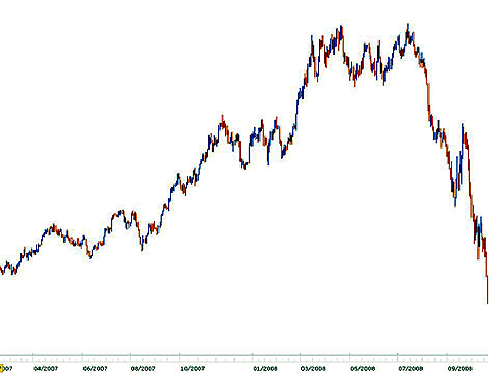
A textbook example of a double top appears in the EUR/USD currency pair shown in Figure 1. Here, the euro makes a high against the U.S. dollar just shy of the $1.6050 figure in April 2008. After two and a half months of stable, range-bound trading, buyers make a final push higher in July before surrendering to sellers. The result is a violent drop until final support is reached at just above the $1.2250 figure.
 Figure 1
Source: FX Intellicharts


Tweezers: the New
Similar to the bearish diamond formation in popularity, tweezers (or kenuki) are relatively unknown, partly because they are strikingly similar to double tops/bottoms. The key difference is in the timing of these two formations. Relatively reserved for the short term, tweezers are composed of two or more consecutive candle sessions. Any more than approximately eight to 10 candle sessions and we may well be looking at a double top or bottom percolating. However, given the short time frame, complete tweezer formations tend to happen quickly. Price is another important factor with the tweezer. In a top or bottom formation, the prongs have exactly the same high prices (in a tweezer top) or low prices (in a tweezer bottom). This idea is key, as it establishes the fact that the price level itself was not broken.

SEE: Introducing The Bearish Diamond Formation and The Art Of Candlestick Charting - Part 1
 Figure 2
Source: FX Intellicharts

In Figure 2, we have a typical tweezer top in the EUR/USD five-minute chart. After an advance higher from previous support of $1.3210, buyers seem to be losing steam. As a result, the first high (point A) is set at $1.3284. After a short, four-session downturn, buyers make a final push higher, marking the second high (point B) at the exact same price of $1.3284. This falls within our definition of a top. The strength of the resistance, and the fact that the price was tested again and failed, helps underlying selling pressure spark the short-term price decline.

Keep in Mind

    The same high or low has to be tested (this is very important).

    The formation follows an extended advance or decline.

    Learn to trade Forex with FXCM’s Free Trading Guide
    Tweezer tops and bottoms tend to form with two or more candles.

    Additional formations are better. Dojis or hammers that create the second peak will add to the signal as it confirms a shift in sentiment.


Trading the Formation
Now let's take a look at applying this setup in the market. Taking the GBP/USD currency pair, we see a perfect example in the short-term, five-minute charts (Figure 3). Here, the tweezer occurs with just two candle sessions following an extension lower from $1.4360 resistance.

    The first low (point A) is established as the last candle in the downtrend closes at $1.4279 in the GBP/USD.

    The second low (point B) is established as the following candle session opens at the $1.4279 low and does not proceed to break it. As a result, we have made the low price twice without violating $1.4279.

    After the second candle session has closed, we place an entry two pips above the close price. A corresponding stop order will be placed just five pips below the $1.4279.

    As a result, keeping with a 2-to-1 risk/reward profile, the take-profit point is at $1.4319 (point C), 30 pips higher. 


    Figure 3
    Source: FX Intellicharts


For a slightly longer-term trade, an oscillator is an especially good confirmation tool. In Figure 4, we simply add a MACD to confirm our USD/CAD short-term trade opportunity.

SEE: A Primer On The MACD


    The first low is set at $1.2201 (point A).

    The second low is set at $1.2201 (point B) three candle sessions apart. Confirmation of this trade opportunity surfaces as it appears a MACD bullish convergence has emerged (point X), lending an upside bias.

    After the close of the second candle, we place an entry order two pips above the close price of $1.2207, or $1.2209.

    At the same time, a stop order is placed five pips below the low at $1.2196.

    The take-profit or limit order is placed 22 pips above, corresponding to a 2-to-1 risk/reward ratio at $1.2231 (point C). 

    Figure 4
    Source: FX Intellicharts

The Bottom Line
Precise and short, the tweezer setup is a great formation that can be used by the currency trader or investor as FX price action tends to follow technical patterns more than any other market. This leaves support and resistance to be tested and retested, giving the opportunity for these formations to surface. Adding strict discipline and rigid risk management rules will help these setups increase a trader's arsenal.

SEE: 3 Technical Tools To Improve Your Trading


~

Find Equity Opportunities With Currency Moves

With everyone trained to look at the same sales figures and gross domestic product (GDP) numbers, it is always useful to find new ways to project a company's earnings or a country's growth rates. For equity investors, foreign exchange fluctuations can mean the difference between a profitable quarter and an unprofitable one, while for currency traders, equity movements can help to determine whether the overall market is seeking risk or avoiding it. With this information, traders and investors can get a better understanding of the close relationship between these two markets and also gain an added advantage in forecasting market direction.

SEE: The Forex Market: Who Trades Currency And Why

The Impact of Currencies on Equities
There are many ways in which currencies can impact equities. For multinational companies, currency fluctuations can increase or reduce foreign earnings. For importers and exporters, exchange rates can impact profitability and sales. Let's take a look at how these relationships work.

Relative Performance Between Industry Peers
Currency fluctuations can mean the outperformance or underperformance of industry competitors. Take Boeing and France-based Airbus for example; the companies realized a divergence in profitability between 2006 and 2007 when the euro appreciated 20% against the United States dollar. Boeing, the U.S.-based airplane manufacturer, saw a sharp rise in orders for its Dreamliner jet. There was a notable shift in interest by foreign buyers once the euro rose from 1.18 to 1.42. Boeing's European competitor, Airbus, on the other hand, suffered greatly due to the strengthening euro. In the third quarter of 2007, Airbus announced that it would be cutting 10,000 jobs and accelerating production of a new super jumbo jet to reverse an $810 million loss.

Importers Vs. Exporters
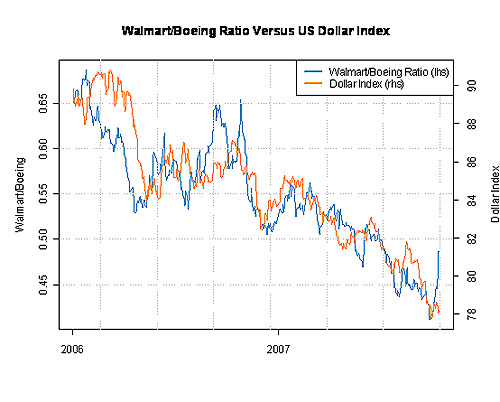
Currency strength or weakness can also mean the difference between one sector underperforming another. More specifically, when the U.S. dollar weakens, companies like Wal-Mart, which imports most of its products, underperforms companies like Boeing, which sells a lot of its jets abroad. In Figure 1, the orange line represents the dollar index while the blue line represents the price of Wal-Mart divided by the price of Boeing. As you can see, when the U.S. dollar weakens, Wal-Mart underperforms Boeing and when it strengthens, Wal-Mart outperforms Boeing. The reason for this is that a stronger greenback means that companies like Wal-Mart have greater buying power, making the cost of foreign goods less expensive. 


 Figure 1:When the U.S. dollar weakens, Wal-Mart underperforms Boeing and when it strengthens, Wal-Mart outperforms Boeing.
Source: DailyFX.com

International Exposure
For multinational corporations, doing business internationally can be a good or bad thing. If your local currency is weakening, foreign exchange fluctuations will boost foreign earnings; if your local currency is strengthening, currency fluctuations could reduce earnings. The period between 2002 and 2007 was one of U.S. dollar weakness. Take McDonald's for example; the advantage that the company's quarterly earnings received from the foreign exchange conversion given their international exposure cannot be dismissed.

SEE: Forex Trading Rules

In 2007, Aegis PLC, the British buyer of advertising space, reported an 18% drop in the first-half profits because of negative currency movements. The U.S. dollar fell 10% against the British pound in the first six months of the year, while the euro fell 1.8%. This adversely affected profits from U.S. and European sales. Companies based in Europe, the United Kingdom and even Canada were feeling the pinch of a lower U.S. dollar as the value of larger contracts with producers suffer when profits are converted back.

Learn to trade Forex with FXCM’s Free Trading Guide
Merger and Acquisition Targets
Sharp currency fluctuations can also lead to an increase in cross-border mergers and acquisitions (M&A). When the Canadian dollar hit a 31-year high in 2007, Canadian companies went on a buying spree. It was not hard to understand why, given that the currency increased 62% between 2002 and 2007. This increase raised the market share of Toronto-Dominion Bank, Canada's third largest bank (as of October 2007) to more than $52 billion, allowing it to announce plans to buy U.S.-based Commerce Bancorp for $8.5 billion. The deal was structured as 75% stock and 25% cash. If TD had engaged in the transaction six months prior to the announcement, when the USD/CAD was trading at 1.16, the deal would have cost $1.3 billion more Canadian dollars, or a premium of 14%.

Canadian banks have announced or completed billions of dollars' worth of cross-border acquisitions in 2007. Currency fluctuations clearly impacted cross-border M&A and it is not uncommon to often see this trend when companies, in countries with currencies that have increased significantly in value, spend their newfound wealth.

The Impact of Equities on Currencies
The strongest relationship that we have seen between equities and currencies is the relationship between carry trades and the Dow. In 2007, you can see many currency pairs that can be categorized as carry trades. The most popular of these are the New Zealand and Australian dollars paired against the Japanese yen. With interest rates at 50 basis points in 2007, the yen became an extremely cheap funding vehicle, not only for investments in higher yielding currencies but also for investments in equities. When the Dow rallies, it tends to reflect a growing willingness of traders and investors to take on risk. Countries that offer higher interest rates do so because they generally have higher risk or lower sovereign debt ratings. That is why both the Dow and carry trades are a measure of risk. This relationship is not foolproof, but generally speaking, when there are sharp gains in the Dow, carry trades tend to rise as a reflection of growing risk appetite. When the Dow collapses, carry trades on Japanese yen crosses will sell off as a reflection of rising risk aversion.

Figure 2 illustrates the close relationship between the Dow (candles) and carry trades (black line) between 2002 and 2007. In this example, the carry trade index is tabulated as a basket composed of the three highest yielding currencies against the bottom three low yielding currencies that are updated daily over 17 years using three-month LIBOR rates for each country. For our universe of currencies, we used the majors (EUR/USD, USD/JPY, GBP/USD, USDC/HF) as well as the commodity dollars (USD/CAD, AUD/USD, NZD/USD). 


Figure 2:The close relationship between the Dow (candles) and carry trades (black line) between 2002 and 2007.
Source: DailyFX.com

Carry trades can and will deviate from equity market returns in the short term, and traders should not necessarily assume that if the Dow rises, carry trades will rise simultaneously. However, what Figure 2 does illustrate is that over the medium term, carry trades and equities are very much correlated. The reason why this is the case is because in its purest form, the carry trade is essentially the never-ending hunt for yield by global investors. When the carry trade performs well, it creates excess returns not only in the form of higher yields but sometimes substantial capital appreciation as well. These excess returns generate a massive amount of capital, which seeks more speculative returns and often find its way to the equity market.

The opposite is true as well where strong stock market gains attract more participants into the market. In order to initiate or increase exposure, many foreign investors, especially those on the hedge fund level will borrow against low yielding currencies like the Japanese yen and Swiss franc to leverage their investments in U.S. equities.

The Bottom Line
Ultimately, foreign exchange is here to stay and will continue to affect companies and the bottom lines in quarters to come. The importance of this relationship continues to grow as companies look over the horizon at global markets and competitors, and expand beyond the U.S. into countries like Europe and Asia. The result leaves sales and product lines exposed to foreign exchange risk. As a result, with everyone in the stock market looking at the same thing, it may very well pay to look outside the box and turn to the currency market as a harbinger of future earnings. Ultimately, this may give the average investor a leg up in a market bent on similar interpretations.

SEE: Economic Indicators


~

Trading Double Tops And Double Bottoms

No chart pattern is more common in trading than the double bottom or double top. In fact, this pattern appears so often that it alone may serve as proof positive that price action is not as wildly random as many academics claim. Price charts simply express trader sentiment and double tops and double bottoms represent a retesting of temporary extremes. If prices were truly random, why do they pause so frequently at just those points? To traders, the answer is that many participants are making their stand at those clearly demarcated levels.

SEE: Using Double Tops And Double Bottoms In Currency Trading

If these levels undergo and repel attacks, they instill even more confidence in the traders who've defended the barrier and, as such, are likely to generate strong profitable countermoves. Here we look at the difficult task of spotting the important double bottom and double tops, and we demonstrate how Bollinger Bands® can help you set appropriate stops when you're trading these patterns.

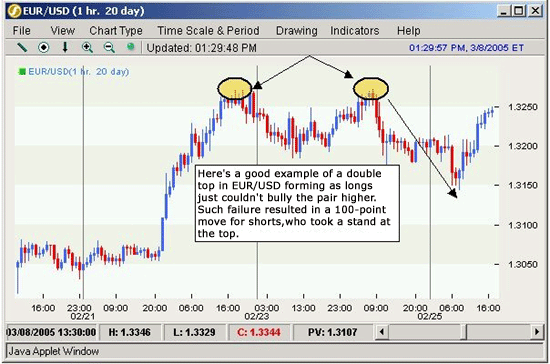
An example of a double top in EUR/USD forming as longs.

 Chart Created by Intellichart from FXtrek.com

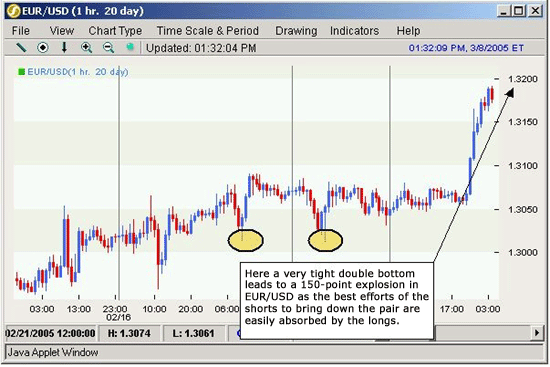
A very tight double bottom leads to a 150 point explosion.

 React or Anticipate?
One great criticism of technical pattern trading is that setups always look obvious in hindsight but that executing in real time is actually very difficult. Double tops and double bottoms are no exception. Although these patterns appear almost daily, successfully identifying and trading the patterns is no easy task.

SEE: A Trader's Guide To Using Fractals

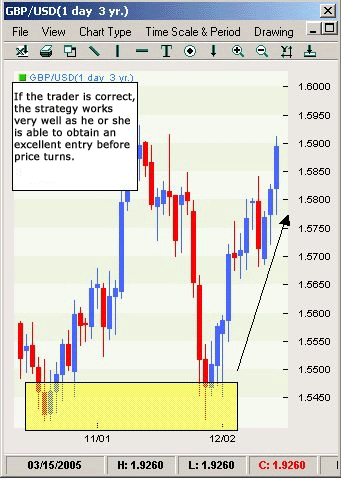
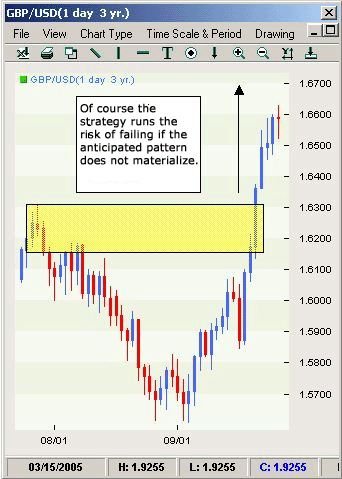
There are two approaches to this problem and both have their merits and drawbacks. In short, traders can either anticipate these formations or wait for confirmation and react to them. Which approach you chose is more a function of your personality than relative merit. Those who have a fader mentality - who love to fight the tape, sell into strength and buy weakness - will try to anticipate the pattern by stepping in front of the price move.

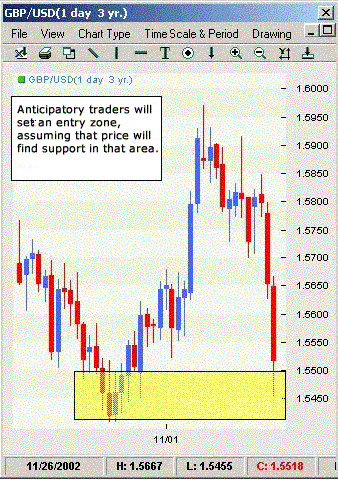
Anticipatory trader will set an entry zone.

 Chart Created by Intellichart from FXtrek.com


The strategy works if the trader is able to obtain an excellent entry.
 Chart Created by Intellichart from FXtrek.com


The strategy runs the risk of failing.
Chart Created by Intellichart from FXtrek.com

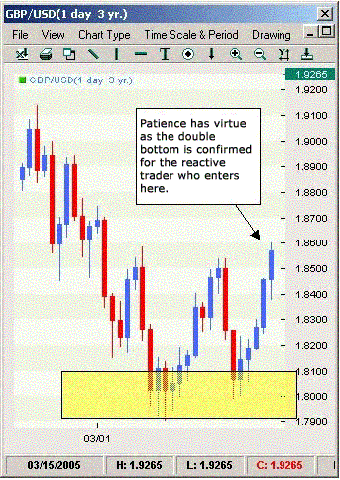
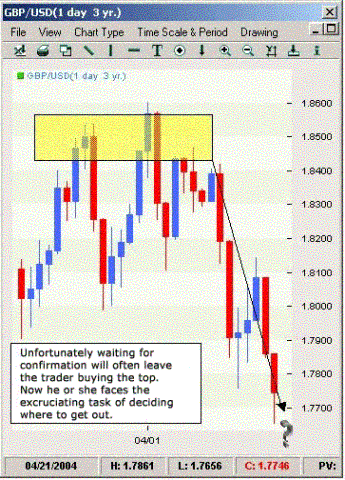
Reactive traders, who want to see confirmation of the pattern before entering, have the advantage of knowing that the pattern exists but there's a tradeoff: they must pay worse prices and suffer greater losses should the pattern fail.

Patience has viture for the reactive trader.
Chart Created by Intellichart from FXtrek.com


Waiting for confirmation will often leave the trader buying the top.

Chart Created by Intellichart from FXtrek.com

What's Obvious Is Not Often Right
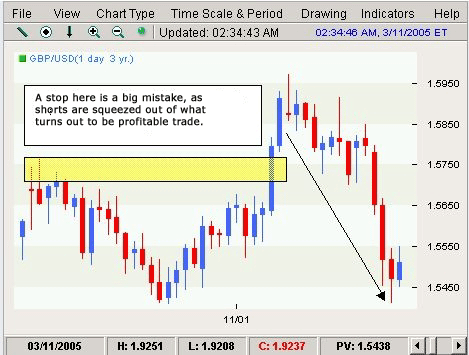
Most traders are inclined to place a stop right at the bottom of a double bottom or top of the double top. The conventional wisdom says that once the pattern is broken, the trader should get out. But conventional wisdom is often wrong.

Learn to trade Forex with FXCM’s Free Trading Guide
Leaving the trade early may seem prudent and logical, but markets are rarely that straightforward. Many retail traders play double tops/bottoms, and, knowing this, dealers and institutional traders love to exploit the retail traders' behavior of exiting early, forcing the weak hands out of the trade before price changes direction. The net effect is a series of frustrating stops out of positions that often would have turned out to be successful trades.

SEE: Introduction To Institutional Investing

A stop here is a big mistake.

What Are Stops For?
Most traders make the mistake of using stops for risk control. But risk control in trading should be achieved through proper position size, not stops. The general rule of thumb is never to risk more than 2% of capital per trade. For smaller traders, that can sometimes mean ridiculously small trades.

Fortunately in FX where many dealers allow flexible lot sizes, down to one unit per lot - the 2% rule of thumb is easily possible. Nevertheless, many traders insist on using tight stops on highly leveraged positions. In fact, it is quite common for a trader to generate 10 consecutive losing trades under such tight stop methods. So, we could say that in FX, instead of controlling risk, ineffective stops might even increase it. Their function, then, is to determine the highest probability for a point of failure. An effective stop poses little doubt to the trader over whether he or she is wrong.

Implementing the True Function of Stops
A technique using Bollinger Bands can help traders set those proper stops. Because Bollinger Bands® incorporate volatility by using standard deviations in their calculations, they can accurately project price levels at which traders should abandon their trades.

The method for using Bollinger-Bands stops for double tops and double bottoms is quite simple:

    Isolate the point of the first top or bottom, and overlay Bollinger Bands with four standard-deviation parameters.
    Draw a line from the first top or bottom to the Bollinger Band. The point of intersection becomes your stop.

At first glance four standard deviations may seem like an extreme choice. After all, two standard deviations cover 95% of possible scenarios in a normal distribution of a dataset. However, all those who have traded financial markets know that price action is anything but normal - if it were, the type of crashes that happen in financial markets every five or 10 years would occur only once every 6,000 years. Classic statistical assumptions are not very useful for traders. Therefore setting a wider standard-deviation parameter is a must.

SEE: Using Bollinger Band® "Bands" To Gauge Trends

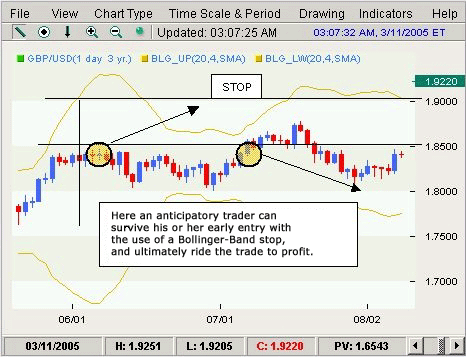
The four standard deviations cover more than 99% of all probabilities and therefore seem to offer a reasonable cut-off point. More importantly they work well in actual testing, providing stops that are not too tight, yet not so wide as to become prohibitively costly. Note how well they work on the following GBP/USD example.

An anticipatory trader can survive.
Chart Created by Intellichart from FXtrek.com

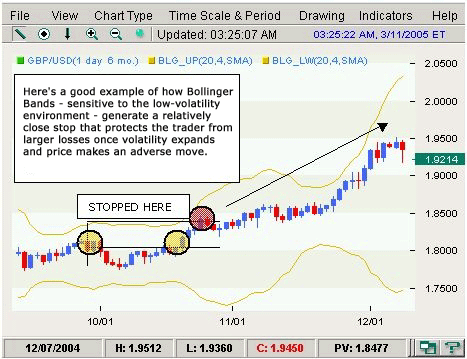
More importantly, take a look at the next example. A true sign of a proper stop is a capacity to protect the trader from runaway losses. In the following chart, the trade is clearly wrong but is stopped out well before the one-way move causes major damage to the trader's account. 
This is clearly wrong but is stopped out well before there are damages.

The Bottom Line
The genius of Bollinger Bands is their adaptability. By constantly incorporating volatility, they adjust quickly to the rhythm of the market. Using them to set proper stops when trading double bottoms and double tops - the most frequent price patterns in FX - makes those common trades much more effective.


~

Trading Forex Trends With MACD And Moving Averages

While the majority of individual investors and traders focus on traditional investments such as stocks, ETFs, options and bonds, the fact remains that the forex market is by far the most active and liquid market in the world. As more and more individuals become aware of the forex market, and learn not only about how to trade currency pairs but also about the mechanics and capital requirements involved, their level of participation continues to grow. While the interest is genuine and the opportunities are real, traders new to this market must still decide just exactly how they will go about determining when to enter and exit individual trades.

SEE: Investopedia’s Forex Walkthrough

Finding the Trend
Most of the trading in the forex market takes place on a short-term basis. Large traders and institutions with high-powered computers and highly sophisticated trading algorithms account for much of the trading in forex pairs. And even for the small trader the lure of short-term trading is strong as it involves limiting the amount of time that capital is at risk. In fact, there is nothing wrong with trading on a short-term time frame. Nevertheless, one still has to decide whether to be bullish or bearish on a given pair before entering a trade. It is here where a longer-term, big picture snapshot can provide a useful roadmap.

Perhaps the oldest adage in all of trading is "the trend is your friend." And this adage has stood the test of time. While any number of short-term trading methods can be profitable, in most cases, it is easier to make money by trading in the direction of the major trend than it is to trade against it. As such, before considering a trade in any forex pair, one must attempt to objectively identify the current major trend of the market. From there, you can attempt to fine tune your actual entries and exits. The primary objective is to focus on long trades when the major trend is bullish, and on short trades when the major trend is bearish. Let's take a look at an example of one way to do this.

Practice Your FOREX Strategies With Our Forex Trading Simulator

Focusing on the Long Term
Figure 1 displays a simple monthly bar chart of the British pound/Japanese yen cross (GBP/JPY). As is the case with any tradable security -- there are times when this pair advances, times when it declines, and times when it trades in a range. Our primary function here is to establish a few simple methods for objectively deeming the major trend as "bullish", "bearish", or "neutral" at any given point in time. No method can be expected to be always right, but our primary purpose here is simply to determine the direction in which to trade (if any), NOT to identify specific entry and exit points.


 Adding Trend Filter No.1
One of the simplest methods for trend-filtering is to apply a moving average to a data set. In Figure 2 you see the same bar chart, however, this time the 12-month exponential moving average has been added. There are advantages and disadvantages to using moving averages. The good news is that they allow a trader to quickly visualize the current trend by simply observing whether price action is above or below the moving average. The primary disadvantage to using moving averages is that a strict use of these to trigger entries and exits almost invariably involves whipsaw signals.


 Figure 2 - GBP/JPY with a 26-month exponential moving average
Source - ProfitSource by HUBB

A rough interpretation of Figure 2 allows us to identify essentially five primary "trending periods" in the pair since 1992.

    From 1992 into late 1995 - primary trend DOWN
    From late 1995 until late 1998 - primary trend UP
    From late 1998 into early 2001 - primary trend DOWN
    From early 2001 until late 2007 (with a brief whipsaw in late 2003) - primary trend UP
    Since late 2007 - primary trend DOWN

As you can see, simply by adhering to the primary trend identified using this simple interpretation could have helped a trader to focus on the best opportunities.

Adding Trend Filter No.2
In an attempt to further refine our identification of the primary trend - and also to afford the opportunity to identify good times to make no trade at all (i.e., when two indicators disagree on the trend) - lets add another indicator into the mix. Figure 3 displays the same chart as that in Figure 2, however, now the MACD indicator is plotted below the bar chart.

The points in time when MACD changed from bearish to bullish are marked with upward green arrows. Conversely, points in time when MACD changed from bullish to bearish are marked with downward red arrows. Note that we have applied relatively long-term parameter values of 18, 37 and 9 for the MACD (the most common defaults are 12, 26 and 9). There are no "correct" values, and some experimentation might be needed market to market. Still, this setting fits in well with our desire to focus on the longer-term trend.

SEE: Spotting Trend Reversals With MACD

 Figure 3: GBP/JPY with 26-month exponential moving average and long-term MACD
Source: ProfitSource by HUBB

At this point we would designate the "major trend" as "bullish", and would consider only long trades if:
a. GBP/JPY is above its 26-month exponential moving average, AND;
b. The latest signal from MACD was an "Up" green arrow.

Conversely, we would designate the "major trend" as "bearish", and would consider only short trades if:
c. GBP/JPY is below its 26-month exponential moving average, AND;
d. The latest signal from MACD was a "Down" red arrow.

Under any other circumstance, we would designate the "major trend" as "neutral" and would not trade the GBP/JPY pair. Namely, if:
e. GBP/JPY is above its 26-month exponential moving average but the attest MACD signal is a down red arrow, OR;
f. GBP/JPY is below its 26-month exponential moving average but the attest MACD signal is an up green arrow.
In case e or f above, we would sit out this particular currency pair.

Summary
One of the keys to trading success is developing the ability to spot opportunities and identify ways to take advantage of them. Clearly a great many opportunities are likely available at any given point in time among the various currency pairs traded on the forex. Trading in the direction of the major trend has long been one of the best methods for improving one's odds in the financial markets.

The specific methods described in this piece should be no means be considered the "be all, end all" of trend identification tools - far from it. In fact, they are presented merely as examples of ways to objectively identify and categorize the longer-term trend. Individual investors may find different and better ways to achieve this task across a cross-section of tradable markets. From there the next piece of the puzzle remains: deciding specifically when to enter of exit trades. Whatever method or methods one ultimately settles on, they will at least enjoy some peace of mind in knowing that they are trading with the primary trend of that particular market.


~

Trading Is Timing

Trading always comes down to timing. To truly appreciate this, we simply need to note that one of the biggest gains in stock market history occurred on October 19, 1987, during the day of its greatest crash. On that day, stocks had declined a mind-harrowing 23% by the end of the day, but at around 1:30 p.m., they staged a massive rally that saw the Dow Jones and S&P indexes verticalize off the bottom, rising more than 10% before running out of steam and turning down to end the day on the lows.

While most traders that day lost money, those who bought that bottom at 1:30 p.m. and sold their positions an hour later were rewarded with some of the best short-term gains in stock market history. Conversely, traders unfortunate enough to have shorted at 1:30 p.m. only to cover in panic an hour later held the dubious distinction of losing money on their shorts during the day of stock market's greatest decline.


If nothing else, the stock market crash of 1987 proved that trading is all about timing. Timing is hard to master, but you can still capture significant gains on an ill-timed trade if you follow a few simple rules.

The Advantage of Avoiding Margin
What happens to traders who are terrible timers? Can traders who are poor timers ever succeed - especially in the currency market where ultra-high leverage and stop driven price action often forces margin calls?

The answer is yes.

Some of the world's best traders, including market wizard Jim Rogers, are still able to succeed. Rogers - and his famous short trade in gold - is well worth examining in more detail. In 1980, when gold spiked to record highs on the back of double-digit inflation and geopolitical unrest, Rogers became convinced that market for the yellow metal was becoming manic. He knew that like all parabolic markets, the rise in gold could not continue indefinitely. Unfortunately, as is so often the case with Rogers, he was early to the trade. He shorted gold at around $675 an ounce while the precious metal continued to rise all the way to $800. Most traders would not have been able to withstand such adverse price movement in their position, but Rogers - an astute student of the markets - knew that history was on his side and managed not only to hold on, but also to profit, eventually covering the short near $400 an ounce.

Aside from his keen analytics and a steely resolve, what was the key to Rogers' success? He used no leverage in his trade. By not employing margin, Rogers never put himself at the mercy of the market and could therefore liquidate his position when he chose to do so rather than when a margin call forced him out of the trade. By not employing leverage on his position, Rogers was not only able to stay in the trade but he was also able to add to it at higher levels, creating a better overall blended price.

Learn to trade Forex with FXCM’s Free Trading Guide
Slow and Low is the Way to Go
For currency traders, the Rogers trade in gold holds many lessons. Experienced traders are familiar with being stopped out or margin called from a position that was going their way. What makes trading such a difficult vocation is that timing is very hard to master. By using little or no leverage, Rogers provided himself with a much larger margin for error and, therefore, did not need to be correct to the penny in order to capture massive gains. Currency traders who are unable to accurately time the market would be well advised to follow his strategy and deleverage themselves. Just like the common cooking saying, success in FX trading is based on the idea that 'slow and low is the way to go'. Namely, traders should enter into their positions slowly, with very small chunks of capital and use only the smallest leverage to initiate a trade.

To better illustrate this point, let's look at two traders. Both traders start with $10,000 of speculative capital and both feel that the EUR/USD is overvalued and decide to short it at 1.3000. Trader A employs 50:1 leverage, selling $500,000 worth of EUR/USD pair short against the $10,000 of equity in his speculative account. On a standard 1% margin account, Trader A allows himself only 100 points of leeway before he is margin called and forced out of the market. If EUR/USD rallies to 1.3100 Trader A is out with a massive loss. Trader B, on the other hand, uses much more conservative leverage of 5:1 only selling $50,000 EUR/USD short at the 1.3000 level. When the pair rallies to 1.3100 Trader B comes out relatively unscathed, suffering only a minor floating loss of $500. Furthermore, as the pair rallies to 1.3300 he is able to add to his short position and achieve a better blended price of 1.3100. If the pair then finally turns down and simply trades back down to his original entry level, trader B already becomes profitable. Both traders made the same trade. Both were completely wrong on timing, yet the results could not have been more different.

No Stops? Big Problem!
Jim Rogers' slow and low approach to trading, while clearly successful, suffers from one glaring flaw: it does not use stops. While Rogers' method of buying value and selling hysteria has worked well over the years, it can very be vulnerable to a catastrophic event that can take prices to unimagined extremes and wipe out even the most conservative trading strategy. That is why currency traders may want to examine the methods of another market wizard, Gary Bielfeldt. This plain-spoken Midwesterner made a fortune trading Treasury bonds in the 1980s when interest rates rose to record yields of 14%.

Gary Bielfeldt went long Treasury bond futures once rates hit those levels, believing that such high rates of interest were economically unsustainable and would not persist. However, much like Jimmy Rogers, Gary Bielfeldt was not a great timer. He initiated his trade with bonds trading at the 63 level but they kept falling, eventually trading all the way down to 56. However, Bielfeldt did not allow his losses to get out of control. He simply took stops every time the position moved a half or one point against him. He was stopped out several times as bonds slowly and painfully carved out a bottom. However, he never wavered in his analysis and continued to execute the same trade despite losing money repeatedly. When bonds prices finally turned, his approach paid off as his longs soared in value and he was able to collect profits far in excess of his accumulated losses.

Gary Bielfeldt's method of trading holds many lessons for currency traders. Much like Jim Rogers, Bielfeldt is a successful trader who had difficulty timing the market. Instead of nursing losses, however, he would methodically stop himself out. What made him unique was his unwavering confidence in his analysis, which allowed him to enter the same trade over and over again, while many lesser traders quit and walked away from the profit opportunity. Bielfeldt's probative approach served him well by allowing him to participate in the trade while limiting his losses. This strong combination of discipline and persistence is a great example to currency traders who wish to succeed in trading but are unable to properly time their trades.

A Little Technical Help
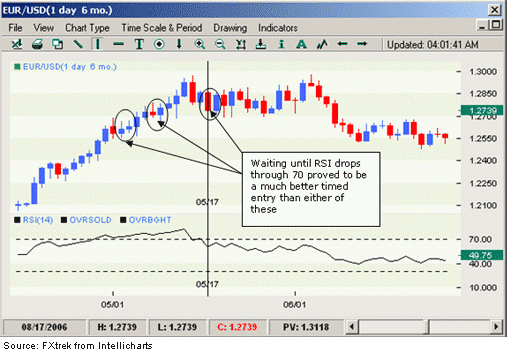
While both Rogers and Bielfeldt used fundamental analysis as the basis behind their trades, there are also technical indicators that currency traders can use to help them trade more effectively. One such tool is the relative strength index (RSI). The RSI compares the magnitude of the currency pair's recent gains to the magnitude of its recent losses and turns that information into a number that ranges from 0 to 100. A value of 70 or more is considered to be overbought and a value of 30 or less is seen as oversold. A trader who has a strong opinion on the direction of a particular currency pair would do well to wait until his thesis was confirmed by RSI readings. For example, in the following chart, a trader who wanted to short the EUR/USD on the premise that the pair was overvalued would have been much more accurate if he or she waited until the RSI readings dropped below 70, indicating that most of the buying momentum was gone from the pair
.


Conclusion
Timing is a vital ingredient to successful trading, but traders can still achieve profitability even if they are poor timers. In the currency market, the key to success lies with taking small positions using low leverage so that ill-timed trades can have plenty of room to absorb any adverse price action. However, trading without stops is never a wise strategy. That is why even poor timers should adopt a probative approach that methodically keeps trading losses to a minimum while allowing the trader to continuously re-establish the position. Finally, using even a simple technical indicator such as RSI can make fundamental strategies much more efficient by improving trade entries. Some of the greatest traders in the world have proven that one does not need to be a great timer to make money in the markets, but by using the techniques discussed above, the chances of success improve dramatically.

~